Guided Capture
Users could take or upload item photographs from the mobile interface.
Isoft developed a mobile-first MVP that captured an item from multiple angles, submitted the images for analysis and returned structured characteristics for operational review.
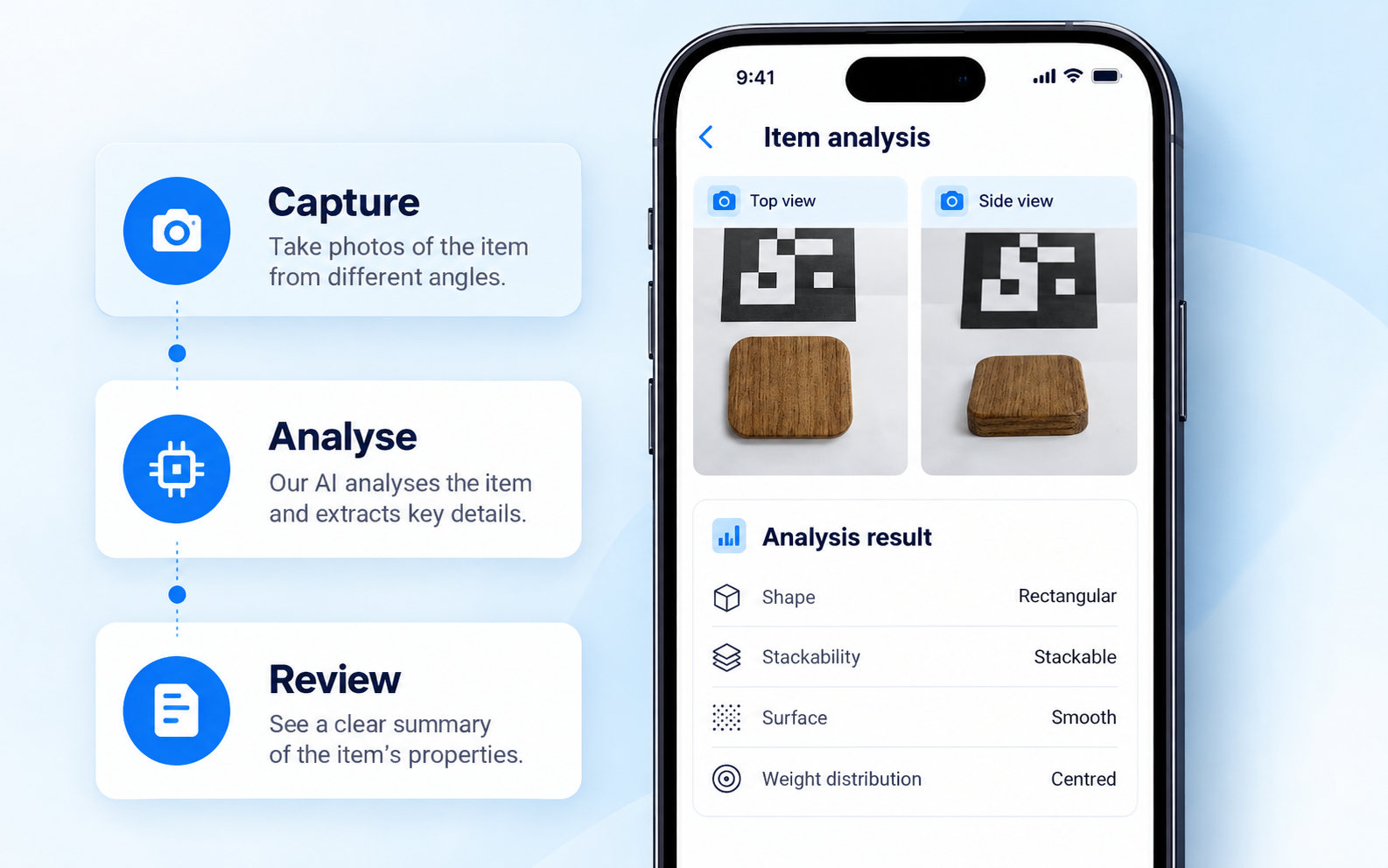
Freight and packing workflows often depend on people inspecting items, recording details and making handling decisions from incomplete information. The MVP was designed to test a more structured camera-led workflow.
The objective was not to replace operational judgement at the prototype stage. It was to make capture consistent, return useful machine-generated attributes and create a practical foundation for validation.
The project focused on proving the end-to-end interaction: capture two views, process them and present structured results for a person to review.
The MVP connected image acquisition, processing and human review in one focused interface.
Users could take or upload item photographs from the mobile interface.
Top and side images provided complementary visual information for processing.
The prototype processed the captured images and returned structured item attributes.
Outputs included shape, stackability, surface and weight-distribution fields.
Processed information was shown in a reviewable table rather than hidden in the model response.
Users retained control through record review, editing and deletion actions.
Photograph the item from the required top and side angles.
Save the selected images and begin the processing step.
The AI-assisted service extracts the item characteristics supported by the MVP.
The user checks the structured output and manages the result record.
The interface was intentionally simple so the technical concept could be tested as a real user journey rather than as a disconnected AI experiment.
The visual shown here is a brand-neutral presentation of the delivered MVP workflow. Client-identifying information and the original development address have been removed.
The MVP demonstrated that mobile capture, AI-assisted processing and structured operational review could be connected into one working flow suitable for further validation and product decisions.
This was an MVP development engagement. The case study describes demonstrated functionality only. It does not claim production deployment, client acceptance, commercial outcomes, packaging recommendations, or validated accuracy and processing-time targets.
Start with a focused MVP that proves the user journey, data flow and operational value before committing to a larger platform.